
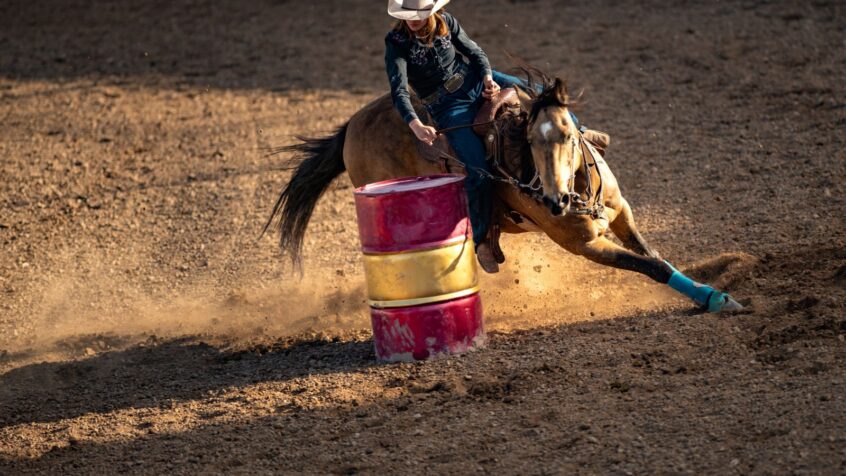
Barrel racing puts a different kind of stress on a saddle than roping or all-around events. Speed, tight turns, and split-second balance shifts mean the best barrel racing saddle has to be light, precisely fitted, and built to keep both horse and rider secure through every phase of the pattern. Here’s what actually matters when comparing options.
What Makes a Saddle Built for Barrel Racing
Weight and Balance
Barrel saddles have evolved more than almost any other saddle type over the past decade, trending lighter with each generation. A heavier saddle adds drag exactly where riders can least afford it — through the turn and out of it.
Seat and Stirrup Placement
Ground seat design and stirrup placement have changed significantly in barrel saddles as the sport has gotten faster. The goal is a seat that keeps the rider balanced through rapid weight shifts rather than fighting against them.
Staying Balanced Through the Turn
Barrel racing creates a unique challenge: the rider has to stay off the front end as the horse sets to turn the barrel, then get out over the horse to drive to the next one. A saddle built specifically for this discipline accounts for both ends of that movement instead of compromising on one.
Tree Fit for Lateral Movement
Barrel horses work through extreme lateral flexion and rapid collection multiple times per run. A tree that doesn’t account for that kind of movement can create resistance right where the horse needs to be most responsive.
Best Barrel Racing Saddles by Priority
Best for Weight and Speed: Tod Slone Series Barrel Racing Saddles
Our Tod Slone Series barrel saddles reflect years of refinement specifically for competitive speed events, built lighter and with stirrup and seat placement tuned for the demands of the pattern.
Best Classic Option: Silver Series
The Silver Series offers a proven barrel skirt design with a 7-year tree warranty behind it — a strong, reliable option for riders who want quality without a fully custom build.
Best for a Fully Custom Fit: Design Your Own
For riders who want every detail — tree width, seat depth, stirrup position — built around their specific horse, start your saddle design and we’ll walk through the options together.
Custom vs. Off-the-Rack for Barrel Racing
Because barrel horses move through such extreme lateral flexion and rapid direction changes, a poor-fitting tree shows up faster in barrel racing than in almost any other event — usually as resistance at the barrel or hesitation coming out of the turn. A custom-built tree, sized to your horse’s back and your riding style, holds up better under that kind of repeated stress.
If you’re still working through the basics of fit, our guide on how to fit a saddle to a horse covers the fundamentals that apply across every event, including barrel racing.
Frequently Asked Questions
What makes a saddle good for barrel racing specifically?
A barrel saddle needs to be lightweight, with seat and stirrup placement tuned for rapid weight shifts, and a tree that accommodates the extreme lateral flexion barrel horses go through during a run.
How much should a barrel racing saddle weigh?
Lighter is generally better for speed events. Barrel saddles have trended significantly lighter over the past decade as riders and makers have prioritized speed over bulk.
What’s the biggest difference between a barrel saddle and a roping saddle?
A roping saddle is built around horn strength and dally security for a stationary or slow-moving moment. A barrel saddle is built around balance and weight distribution through continuous, fast movement.
Why does seat and stirrup placement matter so much in barrel racing?
Barrel racing requires the rider to shift weight quickly and precisely through each turn. Stirrup and seat placement that doesn’t match this movement can throw off timing and balance at exactly the wrong moment.
How does saddle fit affect a horse’s turn around the barrel?
A poor-fitting tree can create resistance or hesitation right at the turn, since barrel horses rely on extreme lateral flexion that a rigid or mismatched tree can restrict.
Is a custom saddle worth it for barrel racing, or is off-the-rack fine?
Off-the-rack can work for casual riders, but the repeated lateral stress of barrel racing tends to expose fit problems faster than most other events. A custom-built tree holds up better under that kind of use.
What tree width works best for barrel horses?
It depends entirely on the individual horse’s wither shape and shoulder angle, not on the discipline itself — which is why a proper fit assessment matters more than picking a size off a chart.
How long does a good barrel racing saddle typically last?
A well-built saddle with a quality tree and proper care can last many years of regular competition use.
What’s the break-in period like for a new barrel saddle?
Most riders notice the leather softening over the first several rides. A properly built tree shouldn’t need a break-in period for fit — that should be right from day one.
Does saddle horn height matter for barrel racing?
Horn design in barrel saddles tends to prioritize a lower profile than roping saddles, since it’s not being used to absorb dally force — comfort and clearance matter more than strength here.
Can one saddle work for both barrel racing and other events?
It’s possible, but a saddle built specifically for barrel racing will generally outperform a multi-purpose saddle in the arena, since the tree and seat are tuned for the demands of the pattern.
What should I compare when shopping for barrel racing saddles online?
Focus on tree design, weight, seat and stirrup placement, and warranty — not just leather tooling or price. These structural details are what actually affect performance during a run.