
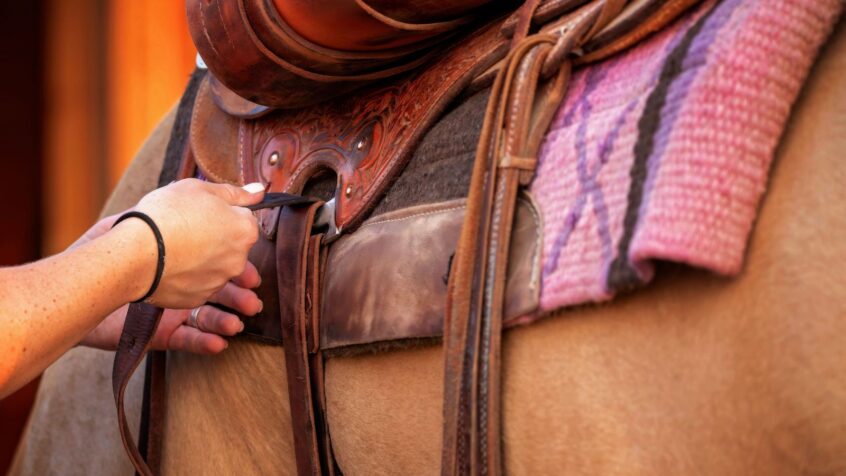
A saddle that doesn’t fit isn’t just uncomfortable — it can cause real, lasting problems for a horse’s back, gait, and performance under saddle. Learning how to fit a saddle to a horse properly is one of the most important skills any rider can develop, whether you’re buying your first saddle or trying to figure out why your current one isn’t working. At Slone Saddles, we’ve spent nearly 40 years building custom saddles in Cuero, Texas, and fit is the first thing we evaluate before a single stitch goes in. Here’s how to check it yourself, step by step.
Why Saddle Fit Matters More Than You Think
A saddle sits at the connection point between horse, rider, and performance. When it fits well, weight is distributed evenly across the horse’s back and the horse can move freely through the shoulder and hip. When it doesn’t, pressure concentrates in the wrong places — leading to soreness, muscle atrophy, behavioral resistance, and in some cases long-term soundness issues. For competition horses especially, poor saddle fit shows up as inconsistency: a horse that won’t collect, won’t extend, or seems “off” for no obvious reason often has a saddle problem, not a training problem.
Signs Your Saddle Doesn’t Fit
- Dry spots or uneven sweat patterns under the saddle after a ride
- Soreness or flinching when you run a hand along the horse’s back
- Bucking, girthiness, or resistance when saddling up
- The saddle rocking, bridging, or sliding to one side
- Visible muscle atrophy behind the withers over time
Any one of these on its own isn’t necessarily a red flag, but a pattern of two or more is a strong sign it’s time to reevaluate saddle fit.
How to Fit a Saddle to a Horse, Step by Step
1. Check Wither Clearance
With the saddle set in place and no rider mounted, you should be able to fit two to three fingers between the gullet and the withers, with clearance running the full length of the bars — not just at the front. Too tight and the saddle pinches; too wide and it can rock side to side.
2. Check Gullet Width and Tree Angle
The tree’s angle needs to match the slope of the horse’s shoulder. A tree that’s too narrow pinches at the top; too wide and the saddle sits low and puts pressure directly on the spine. This is where a lot of off-the-rack saddles fail — horses vary enormously in wither shape and shoulder angle, and a one-size tree can’t account for that.
3. Check Panel and Bar Contact Along the Back
Run your hand under the bars from front to back. Contact should be even and continuous, without gaps or points where the saddle bridges off the horse’s back. Uneven contact concentrates weight into small areas instead of spreading it across the full length of the bars.
4. Check Balance and Level
Step back and look at the saddle from the side. The seat should sit level, with the pommel and cantle balanced — not tipping the rider forward or back. A saddle that sits unbalanced changes how the rider’s weight loads onto the horse’s back, even if the tree itself fits reasonably well.
5. Watch the Horse Move
Fit isn’t just a standing-still check. Watch the horse walk and trot in the saddle, ideally with a rider up. A saddle that looked fine standing still can shift, bridge, or pinch differently once the horse is moving through its shoulders.
Michigan State University Extension recommends roughly two inches of wither clearance for a stock saddle with a rider mounted — a useful baseline if you’re checking fit on your own for the first time.
Off-the-Rack vs. Custom Fit
An off-the-rack saddle is built to a standard tree size and asks the horse to fit the saddle. A custom saddle works the other way — the tree is built around that specific horse’s back, shoulder angle, and the discipline it’s ridden in. For competition horses in particular, event-specific geometry makes a real difference: a calf roping saddle, a barrel saddle, and an all-around saddle all load the horse’s back differently, and the tree should reflect that.
How Slone Saddles Approaches Fit
Every Slone saddle starts with the tree, designed by Tod Slone — a seven-time PRCA NFR Tie-Down Roper who’s spent decades evaluating fit and performance from the saddle, not just behind a workbench. That experience shapes both our Diamond S Series and Silver Series, each built with event-specific tree geometry and backed by an industry-leading tree warranty — 10 years on the Diamond S, 7 on the Silver Series.
If you’re working through fit questions on your current saddle or thinking about a custom build, start your saddle design and we’ll walk through tree, seat, and rigging options built around your horse.
Frequently Asked Questions
How do I know if my saddle doesn’t fit my horse?
Watch for dry spots after riding, soreness along the back, resistance to being saddled, or the saddle rocking or sliding during a ride. Any of these on their own can have other causes, but a pattern of them usually points to fit.
How much clearance should there be at the withers?
Aim for two to three fingers of clearance between the gullet and the withers, with even clearance running the full length of the bars — not just up front.
What is a saddle tree, and why does it matter for fit?
The tree is the rigid frame the saddle is built on, and it determines how weight is distributed across the horse’s back. A tree that’s the wrong width or angle for the horse is the single biggest cause of poor fit.
What’s the difference between a wide and narrow tree?
Tree width refers to the angle between the bars at the gullet. Wider trees suit horses with flatter, broader withers and shoulders; narrower trees suit horses with more pronounced withers. Using the wrong width causes pinching or excess rocking.
Can a saddle be adjusted as my horse’s body changes?
To a point. Panels and padding can be adjusted for smaller changes, but a horse that’s changed significantly in build — through age, conditioning, or weight change — may need a different tree entirely.
How often should I check saddle fit?
At least twice a year, and any time you notice a change in your horse’s behavior, topline, or body condition. Young or actively conditioning horses should be checked more often.
Can an ill-fitting saddle cause lasting damage?
Yes. Prolonged poor fit can lead to muscle atrophy, chronic soreness, and in some cases contribute to more serious back issues. Catching fit problems early prevents most of this.
Does saddle fit differ between roping, barrel racing, and all-around events?
Yes. Each discipline loads the horse’s back differently, so tree geometry, rigging position, and seat design are built differently for a calf roping saddle versus a barrel saddle versus an all-around saddle.
Should a saddle fit the horse or the rider first?
The horse. A saddle that doesn’t fit the horse can cause pain and performance issues regardless of how well it fits the rider. Once horse fit is right, seat size and rider comfort come next.
What’s the real difference between custom and off-the-rack fit?
An off-the-rack saddle uses a standard tree size and asks the horse to fit it. A custom saddle is built around that specific horse’s measurements and the event it’s ridden in, which typically means better, more even weight distribution.
How long does it take to build a custom-fit saddle?
Timelines vary by builder and order volume, but custom saddles generally take several weeks to a few months, since the tree and rigging are built specifically for that horse and rider.
Can I check saddle fit myself, or do I need a professional?
You can catch the basics yourself — wither clearance, panel contact, balance — using the steps above. For a full evaluation, especially if you’re troubleshooting a performance issue, a saddle fitter or saddle maker can spot things that are easy to miss.
Will a thicker saddle pad fix a poor-fitting saddle?
Usually not, and it can make things worse. Adding padding to compensate for a poor tree fit often changes the angle and clearance in ways that create new pressure points instead of solving the original problem.
What should I measure or bring to a custom saddle fitting?
A wither tracing, back length, and photos of the horse standing square are a good starting point. A saddle maker will typically walk you through exactly what’s needed for your horse and discipline.
Does a custom saddle maker visit in person, or can fit be done remotely?
Both are common. Some fit work is done in person, especially for complex cases, while measurements, tracings, and photos allow much of the process to be handled remotely.